
Malcolm Priorrural affairs producer
 PA Media
There will be no more changes to already watered down plans to raise farm inheritance tax, the government has said.
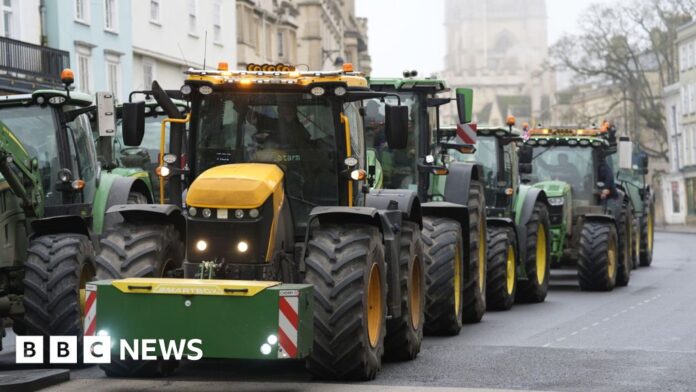
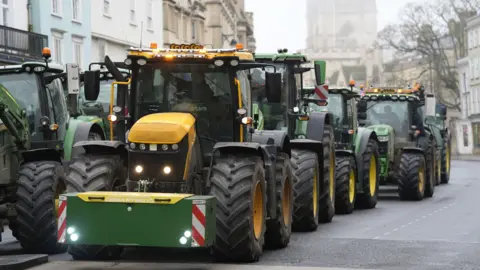
Protestors attempted to disrupt a speech on Thursday by the environment secretary Emma Reynolds at the Oxford Farming Conference with a horn-blowing tractor demonstration
Last month, the government said its planned threshold for a 20% tax on inherited agricultural assets would be raised from £1m to £2.5m.
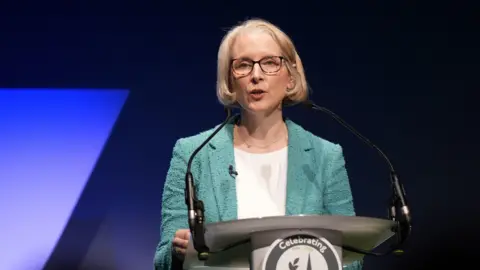
When asked about further changes, Reynolds told the conference: “That’s it, I’m afraid… it is the people in this room who have engaged with us constructively and relatively quietly that have had an influence on this process, not the people sounding their horns.”

 PA Media
The raising of the tax threshold was seen by critics as a climbdown following months of protest over the original plans that were announced in chancellor Rachel Reeves’ first budget in 2024.
But Reynolds told the conference that the government had been listening to farmers, who “aren’t shy about coming forward and giving you their views” and had now “significantly increased” the tax threshold that will come into effect in April.
The government’s original proposals would have seen inherited agricultural assets worth over £1m taxed at 20%, half the standard inheritance tax rate, raising an estimated £520m annually by 2029.
The government had argued that the change would protect smaller farms while stopping wealthy investors from buying farmland as a tax loophole.
However, in December, it stepped back from the original proposal raising the threshold level to £2.5m.
Coupled with an exemption which allows farmers to pass on assets to their spouses tax-free, the new policy means a couple could pass on up to £5m in qualifying assets, without paying tax.
However, the Country Land and Business Association (CLA), which represents rural land and business owners in England and Wales, said it would continue its campaign to “reverse the policy in full”.
CLA president Gavin Lane said the government’s “partial climbdown” in December had come as a “welcome relief” but “was a further acknowledgement that their reforms were ill-thought through and deeply damaging”.
Lane said the policy as it remains is still “so dreadful for the rural economy”.
The National Farmers’ Union (NFU) said that it remained opposed to the tax in principle and would “push for further changes at the next political opportunity”.
But president Tom Bradshaw acknowledged: “News of the change to the inheritance tax threshold just two days before Christmas, and days after my meeting with the Prime Minister, has been a huge relief for many farming families across the country.”
“The change removes the tax burden from a significant number of family farms,” he added.
Environmental payments
The environment secretary also pledged there would be “no more sudden, unexpected closures” of farming payment schemes, as she set out reforms to the flagship environmental programme for England, the Sustainable Farming Incentive (SFI).
Last March, the SFI, which pays farmers in England for “public goods” such as insecticide-free farming, wildflower strips and managing hedgerows, was suddenly closed because funding had been fully allocated for the year.
At the time, the NFU described the closure as “another shattering blow to English farms”.
There has been ongoing uncertainty since then over the programme, a key part of the environmental land management schemes (Elms) which replaced agricultural subsidies after Brexit.
A farming profitability review by former NFU president Baroness Minette Batters, commissioned by the government, warned late last year the sector was “bewildered and frightened”, with inheritance tax and SFI payment changes causing significant ongoing concern.
On Thursday, Reynolds outlined plans for what she described as a “simpler, fairer and more stable” scheme, admitting “mistakes were made” over the payments in the past.
She said the first application window for the new scheme would be in June and would be for small farms under 50 hectares (120 acres) and those not already in a payment scheme. A second wider application window would open from September for all farms.
She backed the overall approach of using agricultural payments to pay for environmental benefits, telling farmers at the conference: “Protecting the environmental foundations of farming isn’t separate from profitability, it’s essential to it.”
The government was looking at changes, including slimming down the number of different nature-friendly farming initiatives funded, limiting the amount of land that could be put into an action, and considering a cap on the amount of money a farm business could receive for SFI, she said.
The Wildlife Trusts said it was now “vital” that the farm payments budget for environmental schemes “is considerably increased” to effectively tackle climate change and wildlife decline.